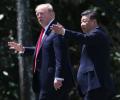
Trump aides, who participated in the two-day talks held at the US President's Mar-a-Lago resort in Florida, described the meetings as productive and said the two leaders exhibited "positive" chemistry.

Unveiling his second year agenda to a deeply divided Congress and nation, a bullish United States President Donald Trump on Wednesday used his first State of the Union address to appeal for bipartisanship on issues like immigration while pledging to tackle the Islamic State and a nuclear-armed North Korea.

Industry watchers attribute a lot of the current successes of the $6 billion Hero Group to how B M Munjal planned and executed succession in HeroCorp, balancing the interests of other family-owned businesses.

'Perhaps the biggest indication was its striking decision in November to delink LeT from its aid certification process.' 'The administration decided that the US, in order to send military aid to Pakistan, would not need to certify that Pakistan is cracking down on LeT.' 'Perhaps the administration was trying to offer a carrot -- in effect, we're backing off on LeT, but in return we expect you (Pakistan) to go after the Haqqanis.' 'Either way, the optics were dreadful for the US given that Hafiz Saeed was released from house arrest a few days after the US move.' 'The US reacted angrily, but eventually it moved on, and refocused on its core concern: The Afghan-focused terror groups.'

'China's growing nexus with Pakistan and the two countries' unresolved territorial disputes with India continue to pose a formidable national security threat to India,' says Brigadier Gurmeet Kanwal (retd).

Part of Sebastian Coe's new job as head of world athletics will be to shift the conversation about his "ostensibly clean" sport from doping to spectacular performances, he said on Sunday.

Biju Janata Dal members had staged a walk-out while NDA ally Shiv Sena did not participate in the voting.

'I am hopeful that you will see more focused attention on this relationship,' former US assistant secretary of state Nisha Desai Biswal tells Alokananda Chakraborty.

'The Trump administration is on the same page as India that Pakistan is not the solution, but the problem itself,' says Rajeev Sharma.

In the last couple of months, the Prime Minister has visited Japan and the US and launched the Make in India campaign to lure foreign investments into manufacturing sector.

Air India must tighten costs to comes out of the red or it wil perish in no time, says experts.

Over two years since the Nirbhaya rape shook the nation women in New Delhi feel no safer than they did before. With safety apps to self-defence classes on the rise, Ritika Bhatia takes a look at what working women in Delhi are doing to keep themselves safe.

'The US wants Modi to succeed because we want India to succeed. For our part, when India thinks of its partners in the world, we want it to think of the US first. That means positioning our country as the preferred provider of the key inputs that can help to propel India's rise.' 'The meeting between Modi and Obama is, and must be, an opportunity for true strategic dialogue -- not a scripted exchange of talking points, but an open discussion of the big questions. What kind of world do we want to live in? What are our true priorities? And most importantly, why does this partnership still matter?'

'The success or otherwise of Modi's foreign policy will largely depend on the equation he is likely to strike with Donald Trump.'
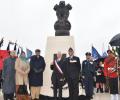
'The Indian Army served with honour and distinction in France and Flanders, East Africa, Gallipoli, Aden, Egypt, Mesopotamia, Palestine, Transcaspia, Persia and even China.' 'The sacrifice of India's soldiers was consigned to the dustbin of history in the post-colonial world.'

Modi is practical person... If he comes in, he will revive the economy and create jobs, says Sanjay Suri.
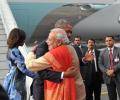
'A three generation US-Pakistan relationship is not likely to be snapped any time soon. All this presents an irritant to an India that wishes to concentrate on economic development,' says Colonel Anil A Athale (retd).

India and Brazil on Wednesday called for urgent progress in reforms of the UN Security Council, as they agreed to scale up bilateral ties and deepen cooperation in international fora.

PM Modi seems to be gradually ending India's strategic ambiguity
One of the biggest ways in which recent government actions have been seen as investor-unfriendly is New Delhi's decision to unilaterally revisit almost every Bilateral Investment Treaty it has signed with other countries, says Mihir S Sharma.
With Ro Khanna defeating eight-term incumbent Mike Honda, for the first time in history the Indian Diaspora has three of its own in the US Congress.

'There is gradual rise in the number of nations viewing Pakistan as the nursery of global terror.'

The State Department and the White House too said that the US expects Pakistan to take decisive action against terrorists operating from its soil.
'It needed political courage on the part of the prime minister to make such an intervention at the present juncture when the hawkish opinion rules the roost in the Indian foreign-policy discourses in our media, and, unfortunately, the sane voices have largely fallen silent,' says Ambassador M K Bhadrakumar.

Lawmakers were not going to be in town on that particular day, and would be in their constituencies preparing for the mid-term elections in November. Rediff.com's Aziz Haniffa reports

The previous United Progressive Alliance government had permitted up to 51 per cent foreign direct investment in multi-brand retail but the current National Democratic Alliance government is opposed to it.
There was no breakthrough in US Secretary of State John F Kerry's India visit, but no breakdown either, says C Uday Bhaskar.

Starting as a maker of hydraulic pumps, the Bengaluru-based company graduated to components for automakers like BMW and Audi, and then Airbus and Boeing
Here's why Rajeev Srinivasan believes there will be nothing particularly positive about the prime minister's US visit.

Majority of India's international routes have been captured by foreign airlines.

The Middle East's power house is about to get a new ruler who is only 31 and he may lead Saudi Arabia for decades, says Ambassador M K Bhadrakumar.
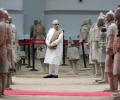
India, China must further strengthen business ties for growth.
'I am hoping that now with the strategic status of our relationship, the Indian voice will get heard in Saudi Arabia,' says Ambassador B S Prakash.

Two US lawmakers write to the House Speaker asking to extend an invitation

India-Israel relations are at a crossroads. Simply chanting old hackneyed mantras on terrorism, secularism, democracy, et al, won't suffice. There is danger of stagnation setting in, says Ambassador M K Bhadrakumar.

Falling margins, high inflation pitting workers against management.

Modi has debunked the uncontested wisdom of foreign and strategic policy remaining unchanged and running on a broad national consensus. This is clearly seen in his unhesitating embrace of the US and the clear hardening shift in India's stance on Pakistan, says Shekhar Gupta.

Silicon Valley can be replicated, but this will only be achieved so long as fresh talent is welcomed by both our countries - a move that will surely spark a billion ideas and discoveries.

'... For the India-US relationship to continue its positive trajectory, it will require India to adapt to a different approach.' Nisha Desai Biswal -- who as the Obama administration's point person for South Asia was in the inner circle of all the Obama-Modi Summits -- tells Rediff.com's Monali Sarkar why she is hopeful that India and the US are on an irreversible forward course.
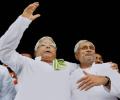
Upendra Kushwaha, president of the Rashtriya Lok Samta Party, which is part of the National Democratic Alliance government at the Centre, admits the Bihar assembly elections will be a close contest and will be fought along the lines of caste.
 © 2026 Rediff.com - Advertise with us - Disclaimer - Privacy Policy - Sitemap - Feedback - About us - Terms of use - Grievances